5.1 Local Bifurcations
Linearization is Efficient
Given a 1D system dependent on a parameter
where
-
Find Fixed Points: For a fixed
, solve for the fixed point, denoted as , by setting . -
Study Stability: Determine the stability of
. (This is typically done by evaluating the sign of the Jacobian, , at the fixed point.) -
Draw the Curve: Draw the curve
in the -plane.
- If the fixed point is stable, draw it with a solid line.
- If the fixed point is unstable, draw it with a dashed line.
- Observe Bifurcations: Observe at which value of
the branch of fixed point terminates (Saddle-Node) or the stability of the fixed point changes (Transcritical or Pitchfork).
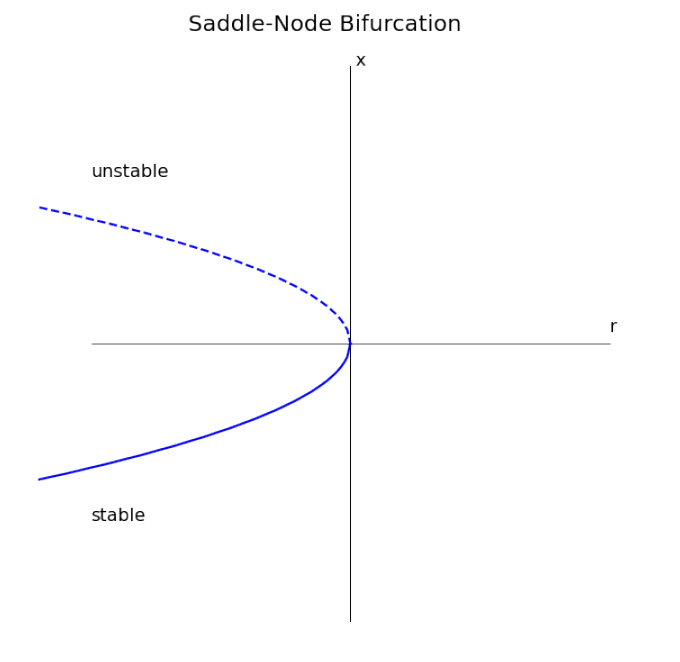
Saddle-Node Bifurcations
Two fixed points collide and annihilate as we modify a parameter
Phase Portrait

Example:
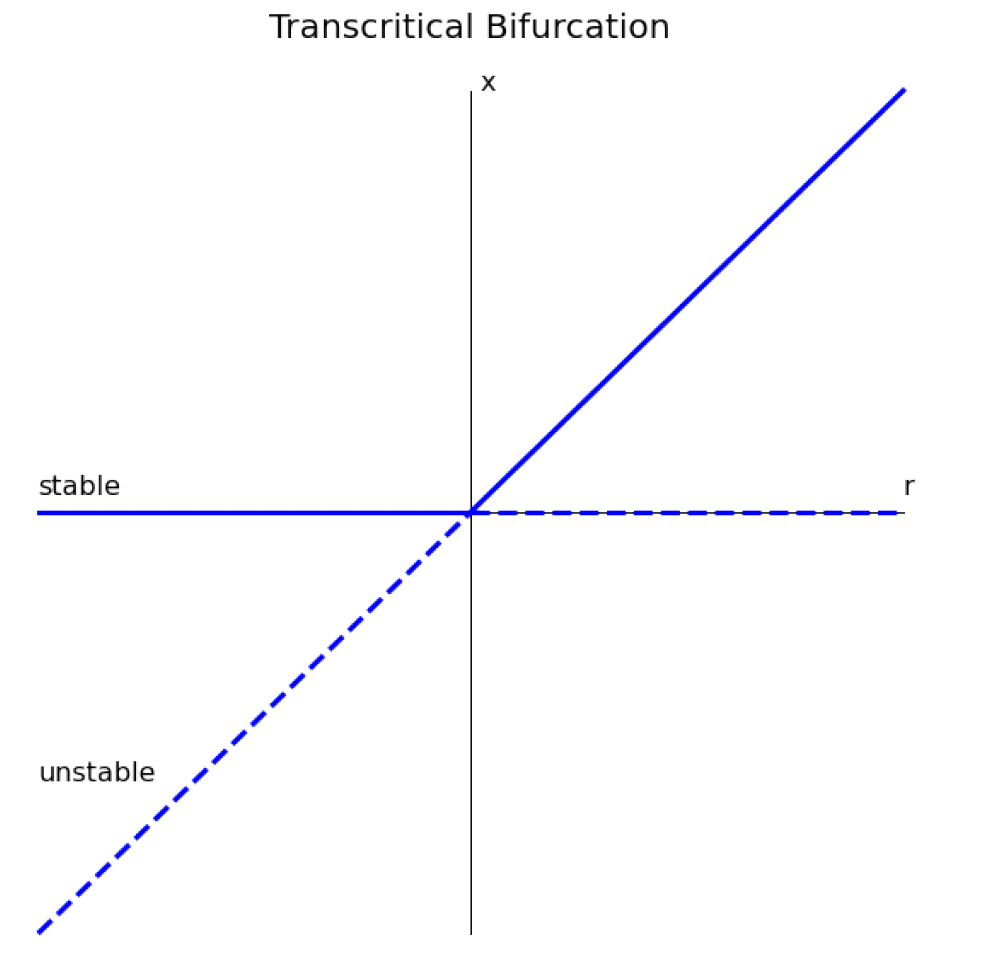
Transcritical Bifurcation
Two fixed points meet and switches stability as a parameter changes

Example:
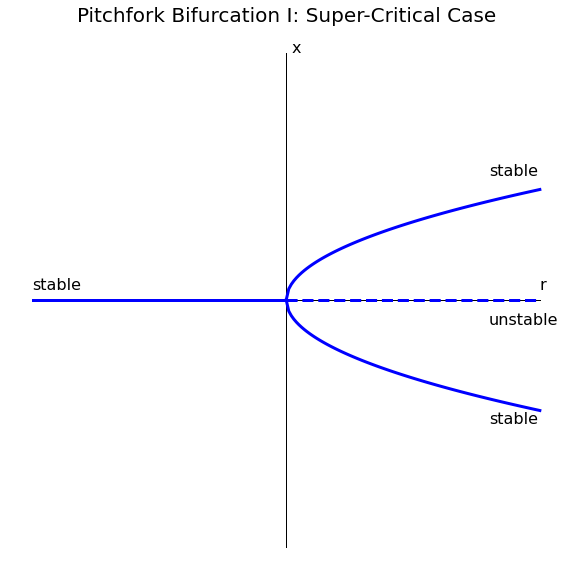
Pitchfork Bifurcation
A fixed point transits into three fixed points as a parameter varies
Super-Critical Pitchfork Bifurcation

Example:
Sub-Critical Pitchfork Bifurcation

Example:
Which would have the a similar diagram as the previous example just flipped over the vertical axis
Hopf Bifurcation
A fixed point loses stability and a periodic solution arises.