We’d like to convert a root-finding problem to a fixed point problem that converges and does so quickly.
In the previous section, we saw that the condition yields quadratic convergence.
Idea: If is a root of and , then is a fixed point of
Furthermore, .
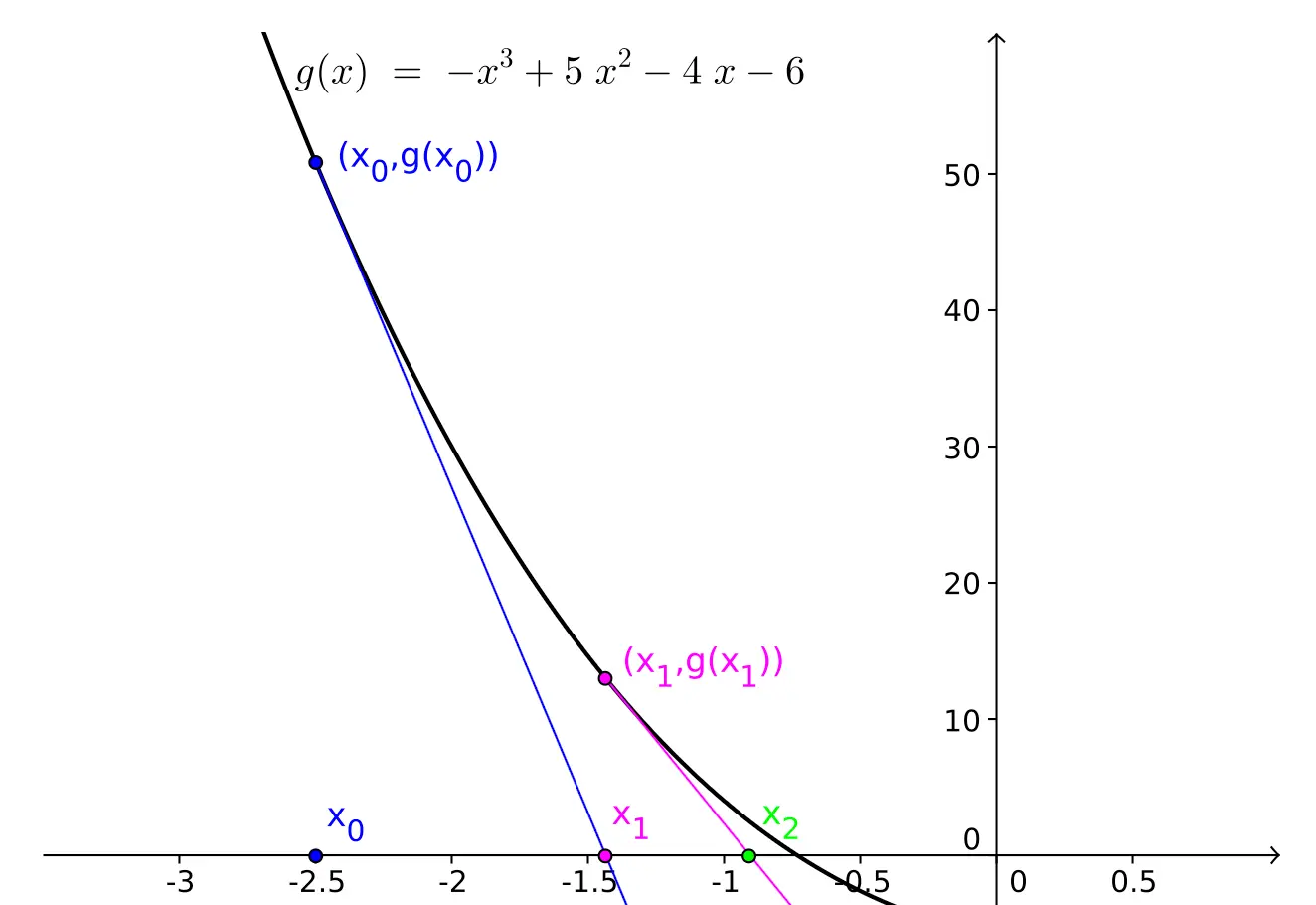
Geometry of Newton's Method
Tangent: is computed from the intersection of the tangent line at and the x-axis.
The “rise” over the “run” must equal . In other words,
Deriving Newton's Method
Input: A function with root , where is differentiable around , an initial point in a neighbourhood such that where . Also a desired tolerance and max iterations .
Output: An approximate close to the root of , or failure.
Outline:
• Given , evaluate .
• If , then tolerance is achieved, so output .
• Otherwise, set .
• Repeat this either until the desired accuracy is achieved (and return the iterate) or until the maximum iterations is reached (print method failed).
Potential issue: What if we don’t know or can’t compute the derivative ?
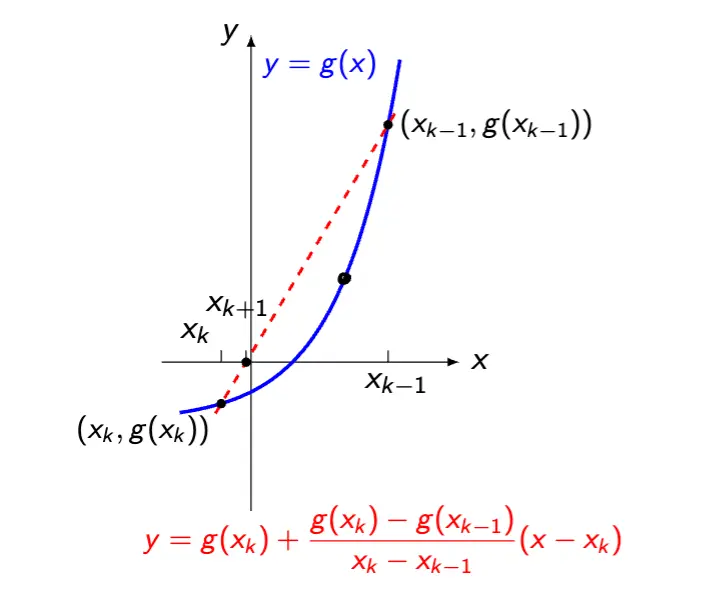
Secant Method
Workaround: Use a difference formula instead:
• This method is called the secant method.
• Need to keep track of two iterates at any given time.
• Need two initial values!
• Some strategies are to pick close to , or to set which works well if is already a good approximation.
• The order of convergence of the secant method is .