Every polynomial of degree has roots (counting the multiplicity)
Polynomial division:
If is root (
, must be degree 0 since we are dividing by ()
We can repeat this process until we get
Another method is:
For any ,
Note that:
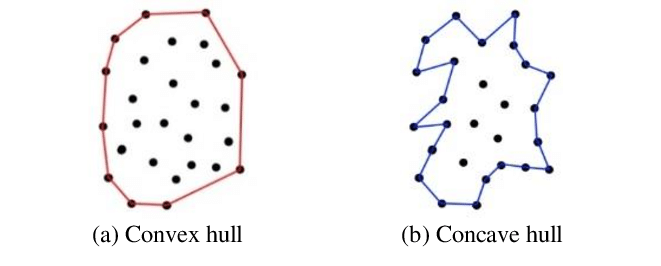
Convex Hull
Convex Set:
A set is convex if the the line that joins any two points in a set is also inside the set.
Convex Hull:
Is the smallest convex set that completely encloses a given set of points
Convex Polygon:
When we have finite points a complex polygon is equivalent to the convex hull if its interior angles are less than
A point is in a complex polygon if we can write that point as
where are the vertices and ,
Gauss-Lucas Theorem:
Let be a complex polynomial with roots . Then the roots of lie in the convex hull of
Proof:
We know that
Assume that
let
Rational Functions
A rational function is a quotient of two polynomials
Assuming and have no common factors.
The zeros of are the poles of .
We can write:
using long division where degree of = degree()-degree()
., substitute :
To clear the fractions, let's find a common denominator is :
Step 2: Analyze the Denominator
.
Substitute and find the common denominator :
Step 3: Combine them to find
Now we just divide the two results:
To simplify this complex fraction,
Now, just group the factors:
Pole
A pole of is a point where or but
Order of a Pole
The order of the corresponding zero of
If is a zero of so that and is not a root of then is the order of the pole.
The Partial Fraction Decomposition Theorem
Theorem: Any rational function can be uniquely decomposed into the form:
where are the distinct poles of , is a polynomial, and each is a polynomial without a constant term.
Proof
Step 1. Isolate the Polynomial Part (Behaviour at )
Using polynomial long division, we can always divide by to get a quotient and a remainder :
By the definition of long division, .
is the polynomial part of .
Let . This is a proper rational function, which means .
Our new goal is to decompose the proper fraction .
Step 2. Isolate the Behaviour at a Single Pole
Let be a pole of . We want to find the "principal part" associated with this pole.
Substitution: Perform a change of variables: .
This maps the pole to the point .
New Function: Define a new rational function :
Since has a pole at , must have a pole at .
Long Division (Again): A rational function with a pole at can be split by long division into its polynomial part and a proper remainder.
where is a polynomial and is a proper rational function (so ).
Check Constant Term: Since is proper, . In -coordinates, corresponds to .
This implies . This forces to have no constant term (or to cancel it). For simplicity, we define as the polynomial in without a constant term that captures the pole at .
Substitute Back: Now, replace with :
Step 3. Analyze the New Remainder (Induction)
Let .
is the principal part for the pole . It's a polynomial in , e.g., .
What is at the pole ? $$\lim_{z \to z_1} H_1(z) = \lim_{z \to z_1} F_1\left(\frac{1}{z-z_1}\right) = \lim_{\zeta \to \infty} F_1(\zeta) = 0$$
Since the limit of at is finite (it's 0), does not have a pole at .
We have successfully "peeled off" the pole at . We can now write:
where is a new rational function that contains all the other poles (), but is analytic at .
We repeat this process (inductively) for and the pole , then for and , and so on.
Step 4. The Final Remainder
After steps, we have "peeled off" all poles:
This final remainder is a rational function.
It has no finite poles (we removed them all). A rational function with no poles must be a polynomial.
It must be a proper fraction, since it's the sum/difference of other proper fractions.
(by definition).
(since has no constant term).
Therefore, .
A function that is both a polynomial and tends to as must be the zero polynomial: .
Conclusion
This leaves us with:
Substituting this back into the result from Step 1 gives the final theorem:
Example
Decompose
This fraction is improper because the degree of the numerator (4) is equal to the degree of the denominator ().
Target Form:
The decomposition will look like this:
is the polynomial part.
are the coefficients for the pole at (order 3).
is the coefficient for the pole at (order 1).
1. Polynomial Part
We use long division. First, expand the denominator:
Now, divide by this:
The remainder is
We now only need to decompose the remainder .
2. Find Coefficient (Simple Pole )
We can use the simple "cover-up" method for the simple pole.